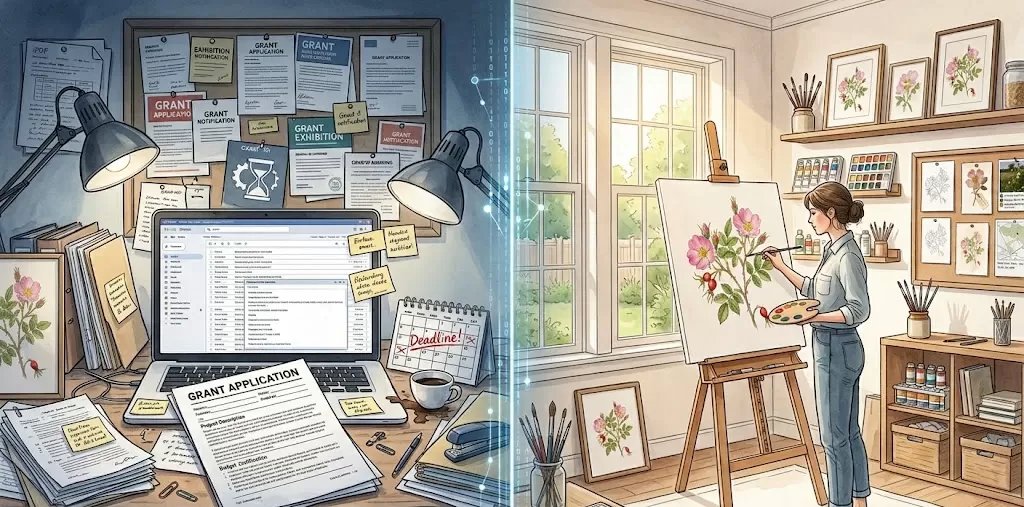
In this piece, you'll learn
The panic has subsided from the initial phase of the art industry's discussion about AI automating work. A couple of years back, the main debate was whether AI would eliminate the need for artists. The more interesting and useful question today is what artists are doing with these tools, which parts of their workflows are ripe for automation, and where human creativity remains indispensable. But recent studies indicate that the narrative of doom was not as dire as it was made out to be. Artists using AI are gaining more time, growing their audience, and focusing on areas that require human skills. One of the most crucial discussions in the arts today is how and what AI work automation means for the creative industry.
It helps to start with a clear idea of what we are discussing before moving into specific applications. AI work automation in the arts is the application of AI technologies, in the form of AI large language models and generative image or audio systems, for automating what previously required a lot of human time in a creative practice. This involves creative work such as brainstorming ideas and technical/administrative work such as emails, formatting portfolios, etc.
What's key to note here is that automation is not the same as replacement. Using AI to draft a grant application is an example of automation in the field of painting. If a composer uses AI to produce variations on a theme, their task is being automated, which is an exploratory task. Neither is being replaced by the tool. AI helps both minimize the tension between the vision and the actual product.
This is important because so much of what's feared about AI in creative practices has been reduced to a false binary. Either AI does it all, or a human does it all. The fascinating space is in the middle, where AI handles the repetitive or generative parts of a process, and humans do the judgmental, tasteful, culturally sensitive, and lived parts.
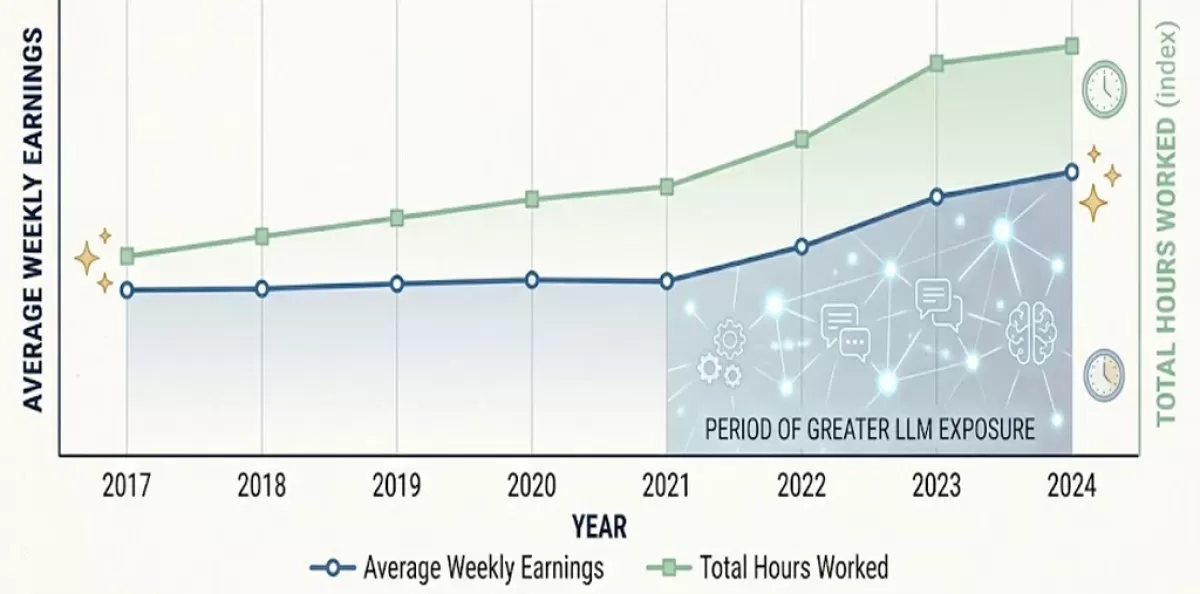
Researchers in the Journal of Cultural Economics analyzed labor market statistics for 7 years, from 2017 to 2024, which produced very interesting results. They found that artistic careers exposed to generative AI have not been affected by the widely anticipated wage reductions. Total hours worked by artists in more exposed occupations increased since 2022 and remained high in 2024.
The same study revealed that artists in the workforce use AI slightly more often than the average worker (1 in 4 artists vs. 1 in 5 workers use AI frequently). More importantly, the study revealed trends in how artists use these tools. Artists are more likely to use AI to generate ideas and explore creative concepts, automate small tasks, streamline information, and facilitate collaboration. They are less likely to use it for operational work such as customer communication or equipment management.
This pattern is a concise narrative. AI is making its way into creative practice, mostly at the beginning of the creative process and at the administrative outskirts, rather than at the heart of artistic decisions. This is where the biggest opportunities for automation lie, and where working artists are already seeing the greatest value.
For artists thinking about where to introduce AI into their practice, it helps to think in categories rather than specific tools, since tools change quickly but categories remain stable.
One of the most relevant areas of AI for automating work for many artists is administrative. All working artists know the work that is not seen, and that holds a practice together. Writing artist statements. Drafting grant applications. Follow-up e-mail to galleries. Composing press releases for shows, updating website copy and creating Bios for various purposes, and responding to inquiries.
These tasks are important but not often satisfying and are time-consuming, time that could be spent in the studio. Much of this work is now well suited to AI tools, especially when the artist is well directed on tone, purpose, and audience. A painter who previously took three hours to prepare a grant application was now able to spend 45 minutes tweaking an AI-generated application, which he would otherwise not have had the time to do. That's a lot of time over a year.
It is important to understand how to provide sufficient context to the AI so that it can generate valuable drafts. Just having a chatbot write an artist statement does not yield a satisfactory result. Sharing your recent work, your themes, the specific opportunity you're applying for, and the tone you want brings you much closer to a usable draft. The artist is the author. The AI is a sophisticated typist.
Administrative automation is part of the larger field of communication and outreach. For every artist hoping to gain an audience, sell art, or meet collectors, curators, or press, there is a considerable communications challenge. Contact follow-up, tailored outreach messages, a newsletter, social media, and answering questions all require time.
AI can create all of these communications, and then the artist can tweak them to sound like them. This efficiency is substantial, especially if the artist is trying to work without administrative assistance. This type of automation will not alter the artist's words; it merely supports them. It saves the effort of saying them.
Creative work is the most sought-after and worrisome category. This is where the difference between automation and replacement comes into play.
Artists who successfully use AI for artistic purposes rarely ask it to create artworks. They use it as a brainstorming partner to generate variations on an idea, find unexpected combinations, or quickly visualize ideas they want to explore further. An AI can create 20 sketches before a designer decides on one to develop. AI can offer a songwriter ideas for variations in the lyrics of a phrase they are struggling with. AI could help a painter see a variety of color combinations before picking a palette to mix their paint.
In each of these examples, the AI has taken over the generative, exploratory phase that the artist might otherwise spend sketching or thumbing through ideas; drafting work is still the product of the artist's own hand and judgment. The exploration has dramatically accelerated, though, and the artist often explores more and more possibilities before settling on a direction.
One more category that isn't always recognized is research automation. Artists are often required to research a subject they want to create work on, whether it's a sequence of paintings on a historical topic, technical information for a nonfiction piece, or imagery for a design. AI can greatly speed up this research process, as it can process and comprehend information much quicker than searching it by hand.
Verification is the crucial step that counts in this case. AI tools can confidently be mistaken; if artists use them for research, they must check the information generated by AI instead of relying on it as a final source. But when used judiciously, AI can save hours of research, freeing time for the creative process.
Understanding where AI automation adds value also requires clarity about where it does not. Several elements of creative practice remain fundamentally human, and no current AI system meaningfully replaces them.
The most apparent drawback of AI is that it has not experienced life. An AI can compose a love song, but it's never been in love. It can create a painting on the subject of grief but has never grieved. This lack is evident in the work and can be felt by both the artist and the audience. AI-produced content often lacks emotional engagement, even when it is technically sound. It also lacks the authenticity of real-world experience, since it is merely a rehash of content produced by others.
Artists who create work based on personal experience and tell specific stories from a particular perspective are creating the kind of work AI cannot replicate. This isn't a minor detail—it's the competitive advantage of human artists in an automated world.
Real-time cultural context is also a challenge for AI systems. They can skim and summarize existing culture, but they can't fully predict what will be relevant in a particular community at a particular time.
Many artists use satire, political commentary, regional identity, or subcultural fluency as a point of reference, and these are areas where AI is less likely to navigate well. One of the most important cultural contexts that a working artist can contribute to their work is this kind of situatedness. This means having an intuitive awareness of the subtleties, humor, politics, and shared references that define a community or subculture, and reflecting those layers authentically in the art. Unlike AI, which can only aggregate and remix existing cultural signifiers, artists draw on lived experience to infuse their work with relevance that resonates in the present moment.
AI is great at churning out lots of options, but it can't actually decide which ones are worth anything. The ability to pick what's good or meaningful is still a uniquely human skill. Sure, AI can spit out twenty logo ideas or a stack of sentences, but only an artist knows which one actually feels right, which one hits that spark.
And that sense of taste? It's not something you just wake up with. It's built from years of making, failing, looking, and learning. AI can copy the look of a style, but it doesn't actually have taste. It can't tell if something is overworked, cliché, or just plain boring. The more options AI can generate, the more important it is for artists to trust their own judgment and say, "No, this is the one."
Artists interested in incorporating AI into their artistic workflow can start with tasks that are time-consuming and energy-heavy but don't directly affect their creative processes. Almost any administrative tasks, communication, initial drafts, and research tasks are safe bets for introducing automation. Time adds up quickly, and the practice's creative process isn't hindered.
Artists can then use AI as a creative partner, exploring and iterating without giving up creative control. The main thing is to be conscious of what you are doing with the tool. An AI-generated artist statement followed by rewriting is not the same as an AI-generated artist portfolio for presentation as your own. The first is a legitimate automation. The second poses a genuine question of authorship and authenticity.
Many AI systems have been trained on artists' work without permission or compensation, a serious concern the field is still working through. If you are using these tools, you should think carefully about whether their use aligns with your values, particularly when generating work in styles closely associated with specific living artists. The widespread use of AI-generated content is also affecting the market for original human work. These concerns are legitimate, and they deserve ongoing conversation within the artistic community.
The evidence so far suggests that AI automation in the arts is shifting how creative work is organized rather than collapsing creative careers. Artists who thoughtfully integrate these tools into the administrative and exploratory edges of their practices are gaining time and expanding what they can accomplish. Artists who refuse to engage with these tools at all may find themselves at a growing disadvantage. Artists who over-rely on AI for actual creative output often produce work that feels hollow and struggles to build genuine audiences.
The productive middle path is where most working artists are already landing. Use AI where it saves time on tasks that do not require your unique voice. Keep the actual creative work in your own hands. Build your reputation on the specificity, cultural fluency, emotional truth, and lived experience that only you can offer. The arts have adapted to every previous technological shift, from photography to digital tools to the internet, and they will adapt to this one too. The artists who thrive will be the ones who use the new tools without letting them use them.
