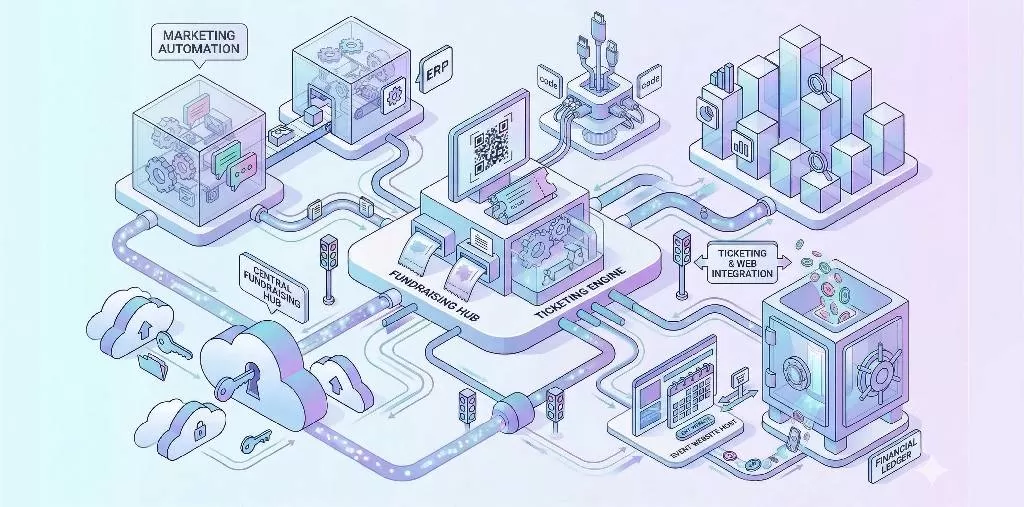
Arts organizations often incur substantial hidden costs that escape typical budget tracking and financial audits. This recurring, often-overlooked cost represents a significant operational inefficiency within most organizations' administrative processes. It is the price of unintegrated systems.
When a box office coordinator exports a ticket sales report from your ticketing site and emails it to the finance department, where theymanually enter the data into your Financial system, that is a cost. When the marketing manager segments an audience by cross-referencing three individual spreadsheets imported from three different platforms, it is an expense. When a patron calls to inquire why they were not given a discount on their purchase because the site did not display their current membership level in your ticketing system, that is a cost. This cost arises from both staff time and the level of trust the patron has in the staff.
These expenses do not appear on paper; they are built into job descriptions. They're seen as normal, as this has long been the case for arts organizations. These costs are growing. In the last decade, the number of platforms arts organizations use has risen sharply, widening gaps between systems that staff silently cross daily. Isolated systems create inefficiencies and make it harder to realize organizational goals. This is the operational reality iPaaS (Integration Platform as a Service) was created to solve. Grasping the true cost of disconnected systems is the first step to seeing that integration is not just a technology investment — it's an operational one.
Ignoring disconnected systems is not just risky; it is a challenge that requires immediate attention. Start by examining your organization's tech stack and identifying gaps. Act now to assess the cost of disconnection and move toward integration for long-term stability and effectiveness.
Clarifying what disconnected systems look like is important before assessing costs. This issue is often more widespread than administrators realize.
A typical mid-sized or larger performing arts center, whether with a performance space or a museum, uses several systems. These include a website CMS, a ticketing or reservation system such as Tessitura, AudienceView, or Spektrix, a patron or constituent relationship management system, an email marketing program, a social media management system, a donor management or fundraising system, and, sometimes, a separate analytics dashboard. This set of tools forms the organization's tech stack, which often becomes a disjointed collection of systems that do not interact effectively. These systems exchange data within a connected architecture. An action by a patron in one system, such as a ticket purchase, membership renewal, or donation, is instantly reflected in all the others.
None of that is done automatically in a disconnected architecture. Every system has its version of the truth. The records of patrons are held in various locations, with varying levels of accuracy. Updates to event information should be made manually on every platform where it is displayed. Several sources and datasets must be extracted before any analysis can be performed on the reports. Each physical interface point between systems is a potential failure point. Failure to communicate across systems creates data silos. Data silos lead to miscommunication, slow organizational processes, and inefficiencies.
The majority of arts organizations are situated on a continuum between complete detachment and complete integration. Very few are at either extreme. However, most people are on the disconnected end of the spectrum than they think they may have consciously decided to be there. Still, it is due to the accumulation of various systems over time that has created the disconnected tech stack. The seams between the systems grew heavier over time as platforms were added one by one. The weight of manual workaround has become so normal that it has become invisible through exposure.
This, the most direct and quantifiable cost, is virtually always underestimated when the arts administrators first set about to quantify it. Keyboarding system-to-system is not something that is done once; it is an ongoing requirement that grows with each event, each customer interaction, and each reporting period. The disjointed systems require workers to spend a lot of time on manual work and repetition, even though these roles take a large part of their week and create inefficiencies that waste valuable resources.
Suppose a performing arts house has a subscription season. Does the patron renewal in the ticketing system automatically refresh in the CRM? Does it cause a welcome-back email on the marketing platform? Does it update their donor status in the development database? In a disconnected architecture, each such update is a manual process carried out by an employee. Multiply that by the hundreds of times it can be renewed each season, and by additional ticket purchasers, group sales, membership upgrades, and donation transactions, and the total time spent by the staff in data transfer between systems that are not integrated may be in the dozens of hours per week.
A reasonable estimate for a medium-sized performing arts organization is 15-25 personnel-hours per week spent on manual data synchronization. With an average administrative wage bill, this amounts to 25,000 to 45,000 per year wasted on shifting data between systems, rather than building patron relationships, running programming, or fundraising. Automation and better integration could eliminate this administrative inefficiency.
In the long term, this lack of efficiency will frustrate staff, affect morale, and may also cause staff turnover in arts and cultural institutions.
Data entry is manual, leading to errors. It doesn't imply any comment on staff competence; it is a feature of manual processes. When a patron's contact information is updated in the ticketing system but not transferred to the CRM and email platform, the patron will start receiving communications to a stale record. If a ticket purchase is recorded in the ticketing system but the matching patron account in the donor database is not updated, a development officer might contact a patron as a lapsed donor when the patron is a subscriber.
Any data errors within arts organizations will cascade. Different data sets increase the likelihood of compliance failures and audit failures because fragmented systems cannot easily maintain a single source of truth. One misrecorded patron influences communications, donor strategy, event attendance tracking, and lifetime value. In cases where an organization requires data for its audit or reporting practices, disconnected systems complicate the process more than linked systems do, and when project data needs to be obtained from various sources, the process is not only time-consuming but also error-prone. A data error does not cost as much as the time it may take to fix the record it has caused to date, but rather the sum of all the decisions made using erroneous data held before it was found. In patron relationship management, where the development strategy is based on long-term relationship intelligence, data errors are not merely operational inconveniences. They are strategic liabilities and pose significant risks to the organization.
Your communications can not capture what your patrons have actually done when your marketing platform lacks access to real-time patron purchase data in your ticketing system. A customer who has purchased a ticket to three performances in this season can receive the same general newsletter as a customer who attended two performances two years ago. A first-time customer who attended a family concert is offered a subscription to a chamber music series that they expressed no interest in. Disconnected systems lead to missed opportunities for personalized engagement, negatively affecting the overall customer experience.
The price here will be based on engagement, conversion, and donor retention rates. Arts organizations that have linked systems that facilitate segmentation of behavior are always performing better than those that do not have them in all email marketing measurements: open rates, click-through rates, conversion rates, and unsubscribe rates. This contrast is not in the merit of the writing or the design of the email - it is in the topicality of the content for the receiver. Relevance requires data. Information needs interrelation between systems.
When your website is not linked to your ticketing service, the information there is correct at the time it was last manually entered into the website and incorrect thereafter until it is updated again. Lack of integration between systems will result in old or misleading information being presented to patrons, and this will cause a lack of confidence and confusion. Take the case of a performance that will be sold out in an hour; even on your site, you can see that tickets are available since there is no integration between the ticketing system and the site. Something that occurred last week still has the old time displayed in your internet calendar. One of the membership features that your Tessitura or Spektrix system records right is the one that will not be visible to a patron accessing your website, since there is no integration between the two systems.
All cases of false data on your site are likely due to patron failure. When a customer who has to travel by car to find an empty seat gets the impression that something was available on your site, it is hard to forget that experience. When a patron comes in at an inopportune moment because your website was not manually updated, they do not blame the fact that no one was available to do it (they blame your organization). The reputational damage from perpetually misleading site data is difficult to estimate, but it always affects patron surveys and exit interviews of lapsed subscribers.
Leadership of arts organizations, development teams, and boards increasingly needs cross-platform data insights: what is the correlation between subscription tenure and donor conversion? What is the lifetime value of a customer who initially came with a school party? What are the effects of email engagement within 90 days of a renewal deadline on renewal rates? The answer to such questions cannot be based on a single system since the corresponding data resides in numerous systems. Increased data may not be useful when it is distributed across disparate systems, as this prevents organizations from obtaining valuable strategic insights.
Without such platforms connected, responding to such questions requires a data assembly process: export the ticketing system, export the CRM, export the email platform, merge into a spreadsheet, reconcile differences across patron records, and then analyze. Each report takes hours to do this. It is error-prone. And it gives a snapshot of the picture, not a live one, so that by the time the report is finished, the information it captures is already outdated. Inefficient reporting interferes with business operations and wastes resources, because employees spend too much time on manual work rather than focusing on the mission.
The price is quantified in terms of the quality of the decision-making. Arts organizations that can quickly gain cross-platform insights can make superior decisions on programming, pricing, donor strategy, and patron retention than those whose reporting procedures deter the very questions in the first place.
It is the cost of disconnected systems that has the least discussion, though it is one of the most consequential costs. Arts administration recruits gifted individuals who are interested in working on relationships with patrons, program strategy, community involvement, and artistic purpose. It fails to recruit talent, as they would prefer to devote a significant portion of their time to data transfers between software platforms. Lack of integration causes employees to focus on manual, repetitive work rather than on strategy, and then on activities that create real value for the organization.
When administrators with the ability spend hours a week entering and reconciling data manually, two things happen. To start with, the job they were employed to perform, building rapport with patrons, fundraising strategy development, and implementing marketing campaigns, are squeezed into the remaining time. Second, the aggravation of using one’s professional time on what seems like something that should be automated builds up into a tendency of detachment and eventual exit. Workers who cannot concentrate on high-value activities tend to quit, making it more difficult for the organization to retain the best workers.
The loss of talent in arts management is a long-reported problem. There are more than one reason, although operational inefficiency is a constant factor. Replacing an established arts administrator in terms of recruitment and onboarding, loss of institutional knowledge, is usually one or two times the annual salary. The elimination of manual data entry through integration is not only about efficiency gains. It is an employee retention program.
It is more difficult to internalize abstract costs than concrete situations. Think of the opening of a new season of a Presenting performing arts center with disconnected systems. This is because tools and inefficiencies would cause the average business to lose part of its annual revenue, and arts organizations are no exception.
Most ED's when setting up the new season have a vague understanding of what kind of programming brings in the most number of patrons. But, if they had a connected system with historical data at their finger tips, they could easily see how popular each show type is, and whether their popularity is trending up or down. This would enable them to create a season that will excite their audiences and improves their bottom line.
The next place where connectivity is most impactful is the marketing department. Before the opening, the marketing staff had developed an email campaign to promote the season. The audience list was collected from the ticketing system, and passed to the email marketing platform. At best, the Ticketing system is directly in communication with the email marketing platform and all the marketing departyment has to do is select a group or groups that will be targeted by the campaign. Unfortunately, for most organizations, this list is not cleaned, and de-dup'ed. The process ensured that many of the patrons received multiple copies of the campaign, and caused some annoyance with the target audience. Meanwhile, the web team had to manually update the event listings on the website from the exported ticketing data, by cross-referencing these with the printed season brochure.
The opening night event itself, was created on a separate environment, because the ticketing system did not support a fund raising pre or post event program, and some of the invited guests got duplicate seats which were distributed by both the event page, and reserved by the development department.
During the opening night, the house is sold out at the box office. The site keeps displaying the available tickets for 3 hours because the ticketing platform and the site do not communicate in real time. Fourteen clients come to the facility with tickets purchased via a third-party platform that was crawling the site for availability information. Box office staff takes 1 hour to address the situation.
Next Monday, the development team will want to know which attendees at the opening night are lapsed donors to use as a foundation for the post-event re-engagement campaign. The data analyst takes 4 hours to cross-reference the ticketing system attendance export with the donor database, matching names and addresses. This is close to 30 per cent of records that can not be accurately matched, as there has been a drift between the patron data in the two systems.
None of this is dramatic. None of it constitutes a disastrous failure. It is merely how usual affairs appear in a performing arts venue operating fragmented systems and depending upon fragmented instruments. And what iPaaS does away with, in particular, is an arts-native iPaaS such as ARTdynamix. To get a more in-depth look at the technical functionality of the integration layer, read How iPaaS Works: Benefits, Tools & Best Practices for Arts Organizations.
If arts organizations adopt the related iPaaS architecture, the operational changes are concrete and immediate. System integration and integrated systems enable seamless operations and a connected experience for staff and patrons. By integrating various software platforms, organizations can remove silos, streamline processes, and ensure a smooth flow of data across departments. This benefits the integrated experience for all and offers a competitive advantage through enhanced data and decision-making speed. It would be interesting to map these changes at the system level to contrast them.
With your website CMS integrated with Tessitura, AudienceView, Spektix or Ticketmaster via an iPaaS layer, seat availability on your website is updated in real time whenever someone buys a ticket. Details of events, such as time, date, and description, cast lists, and access information can be stored in a single source and automatically sent to the website, eliminating the need to hand-copy them in each location. On sold-out performances, the update is immediate. New events announced are updated on the site once they are entered into the ticketing system.
All patron interactions in the ticketing system, including ticket purchases, membership renewals, subscription upgrades, gift card redemptions, and so on, Should be easily integrated into the Financial system as record updates. The ticketing system should automatically provisions new patron payments in the financials. Transaction data is automatically added to existing records. Your Financial Software represents the state of your organization at any given time, rather than the state of the previous manual export.
In the case of CRM integration with the email marketing platform, the audience segments will be built from live behavioral data. The segment of patrons who have gone to 3 or more events this season, but have not donated, is automatically current - it is updated as they get qualifying transactions. Patron-driven campaign triggers include lapsed subscriber re-engagement, post-attendance follow-up, membership renewal reminders, etc. This type of campaign trigger automatically fires at the appropriate time and does not require a manual list pull before all campaigns.
Cross-platform reporting is a query and not a project with a connected architecture. The information needed to respond to questions about the lifetime value of patrons, donor conversion, subscription renewal, and marketing attribution is in a single view, rather than in separate systems exporting the data separately.
The expenses outlined in this article are not imaginary. They are the working facts that ARTdynamix was created to address - two decades before the emergence of the iPaaS as a term. The problem of detached systems affecting the performance of companies in the arts industry is common.
ARTdynamix clients are performing arts centers, symphony orchestras, museums, arts schools, and cultural institutions, all of which have historically operated under the disconnected structure described herein. We are the primary integration solutions provider to arts organizations, so our effort has been to substitute the said architecture with a connected one: a single platform that serves as their web presence CMS and the integration layer that binds the web presence to the ticketing, patron management, and marketing systems they rely on.
The integration connectors ARTdynamix offers to Tessitura, AudienceView, and Spektrix are not generic API connections. They are integration-tested productions that are based on decades of experience with the precise data architectures, API behavior, and operation patterns of each platform. Project-based workflows prevalent in arts organizations are also supported on the platform, enabling users to manage projects easily and maintain real-time visibility into project performance. As Tessitura changes its API, our connector changes as well. If AudienceView modifies its authentication model, our integration handles the process. The operational load that the arts organizations would have otherwise incurred is absorbed into the platform.
The outcome is that the ARTdynamix clients do not incur the hidden expense found in this article. Their human resources are spent on customer relationships and programming. The information on their ticketing platform is in real time on their site. Their marketing campaigns are based on behavioral information, not on handlist management. These reports are generated from interconnected data rather than built from unconnected exports. ARTdynamix will enable organizations to save money and eliminate unnecessary spending through reducing operational inefficiencies. You may have a glimpse of what this looks like at artdynamix.com/integrations.
Unspent overheads of disconnected systems of arts organizations are tangible, ongoing, and quantifiable - even when they are not incurred anywhere in a budget line. The direct effects of running a technology stack in which systems lack communication between them include staff time, data errors, generic patron communications, inaccurate information on the website, inefficient reporting, and talent retention problems.
The positive side is that such costs are not unavoidable. They are the result of a particular architectural issue, which is disconnected systems, with a particular architectural solution, iPaaS. And for arts firms, there is no need to invest enterprise IT resources, development projects, or a disruptive technology overhaul. It needs an arts-native integration platform that understands the systems your organization relies on and how to bind them together with connectors tested in production and designed to meet the needs of the arts sector.
This is the issue that ARTdynamix has helped arts organizations solve over the past 20 years. Just in case you would like to see what the connected version of your technology stack would look like -and what it would do to your employees, your customers, and your performance-wise effectiveness- book a demo with our team, and we will walk through your specific platform environment together.
Start with staff time. Request that every member of your administrative team estimate the number of hours they dedicate to activities that account for the majority of transferring, re-entering, and reconciling data across software platforms. Divide by their annual rate and multiply by their hourly rate. Next, include the cost of error correction time - the number of hours taken to correct anomalies in the data, correct the records of the patrons, and correct the booking errors that were caused by the fact that information is not in sync across the systems. When made visible, the aggregate number of most arts organizations comes as a surprise to most people.
To the majority of arts organizations, the answer is no - especially when considering arts-native iPaaS platforms that have ticketing system connectors built in and do not need to be custom-programmed. The cost of implementation is usually recouped within one to two years, with savings in staff time alone, without accounting for the benefits of improved communication with patrons, higher donor conversion rates, and reduced errors. The better way to frame it is that the cost of being disconnected is an annual recurring cost, whereas the cost of integration is a one-time implementation cost, with a lower ongoing operating cost.
Most high-end ticketing platforms, including Tessitura have a well-documented API that enables integration with external systems. But the intricacy of Tessitura data model - its patron record model, its subscription and membership model, its event model - implies that only a fraction of the functionality of a dedicated integration can be achieved with a general iPaaS connector. ARTdynamix has native Tessitura integration that mirrors the platform's actual data structure and years of experience with the product on the production system. You can learn more at artdynamix.com/tessitura-network.
The association between the public site and the ticketing system is the greatest value of the first integration of most arts organizations. Here, the most noticeable areas where the gap in patron experience lies are the lack of accurate availability information, out-of-date event listings, and disconnected transaction flows — these are the direct results of what patrons observe and experience. The integration is also the one that creates the most immediate and measurable improvement in how operations work. Based on that, the further logical links include ticketing to CRM and CRM to marketing platform.
Yes, and it is one of the least-exploited features of arts organizations that use iPaaS. Having the ticketing platform linked to the donor management system via an iPaaS layer provides the development team with real-time access to patron purchase history. Attendance patterns can be used in donor propensity models. Attendance milestones can be used to elicit re-engagement campaigns. The entire patron history of all tickets purchased, all events attended, and all donations collected is visible in a single interconnected record, rather than spread across multiple systems.
