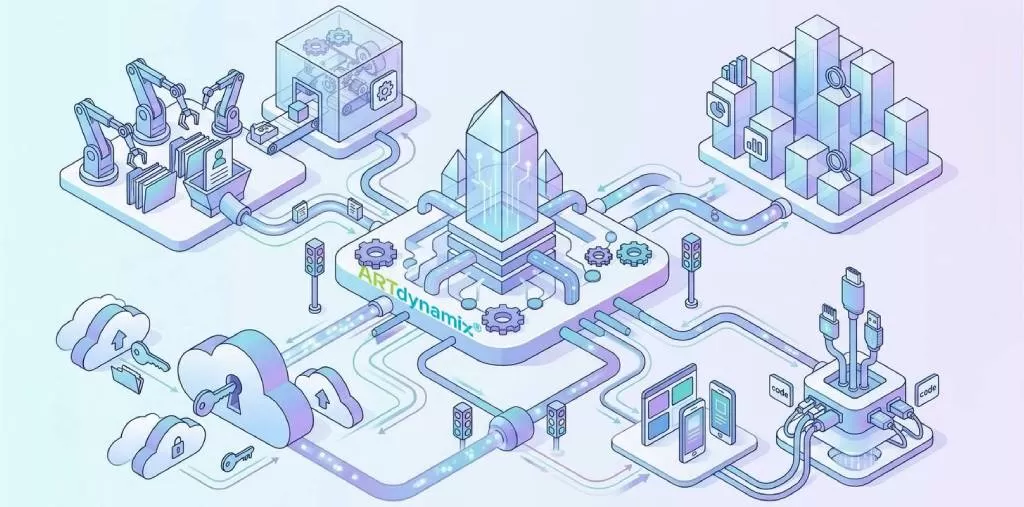
You already know the frustration of managing a museum, a performing arts center, a symphony orchestra, or an arts school. Your ticketing system operates in one silo. Your customer database lives somewhere else. Your website is isolated. The other systems are unaware of your marketing initiatives. Whenever a piece of information needs to pass through all of them, a team member must enter it manually.
Technology isn’t the problem. The real issue is integration failure, which has long burdened arts organizations.
The good news? Now there is a name for the solution: iPaaS, or Integration Platform as a Service. It can also be spelled iPass. Same idea, various spellings. The term is new to most, but the need it fills dates back to when the first arts organization tried to link a ticketing system to a website.
ARTdynamix, has pre- built integrations for arts and entertainment organizations stemming from more than 20 years web development for the arts. Long before the term iPaaS existed, our solutions helped the art organizations simplify their website development and improve the quality of patron experience. ARTdynamix is the first and to-date ,the only, arts-native iPaaS. It is a platform designed to integrate with tools that arts organizations rely on, such as CMS, CRM, fundraising tools, and ticketing systems like Tessitura, AudienceView, and Spektrix. No custom development or data silos are needed.
This guide will serve as your comprehensive resource for iPaaS in the arts and entertainment industry. What it is, why it is important to your particular organization, how it has evolved, and what a fully integrated arts technology stack would look like in real life.
iPaaS stands for Integration Platform as a Service. This is a cloud-based tool that allows different software systems to work together. It helps those systems share information, perform actions based on that shared data, and keep everything up to date simultaneously. You do not need to write special code for each system to talk to the others. iPaaS manages these connections for you.
For a general enterprise, iPaaS could help integrate a CRM and an ERP with a data warehouse. In the case of an arts organization, the integration dilemma takes a different form but remains complicated. You are making a publicly facing site connected to a ticketing engine, a patron manager system, an email marketing system, and possibly even a donor management system, all of which were developed in separate silos and were never intended to interface with one another.
IBM defines iPaaS as a set of self-service, cloud-based applications that enable the integration of applications, systems, and data sources across various IT environments. That definition is accurate, albeit generic. The more practical definition of an arts organization is the following:
In arts organizations, an iPaaS serves as the integration layer between your website, ticketing platform, patron database, and marketing tools. It coordinates and automates these tools, so you have a single operational site. No more manual data entry or asking your developer to write code.
This is the challenge ARTdynamix was built to solve, and the issue this guide will help you fully understand.
To recognize the significance of iPaaS in contemporary times, it is best to understand what preceded it. Fragmented systems did not always pose a problem for the arts organizations. The fight escalated because the number of tools they depended on increased.
In the early days of digital infrastructure, organizations used to connect two systems. If you required your ticketing system to communicate with your email system, a programmer wrote specific code to interface the two systems. This worked on a small scale. As soon as you introduced a third system, then a fourth, the network of custom relations could no longer be maintained. Any change made in one system was likely to break the connections of the rest.
The next stage was the Enterprise Service Bus (ESB), an integrated messaging platform. It routed data between applications via a central hub. ESBs supported on-premises legacy systems, but were expensive to set up and maintain. For arts organizations with small IT teams, ESBs were often not practical.
The present generation of integration technology is the iPaaS. It is cloud-native, meaning there is no infrastructure to set up or maintain. It operates on pre-designed connectors, API-based workflow engines, and visual configuration interfaces, enabling work integration to be assembled and managed by non-coders. Gartner predicts that the global iPaaS market will reach over 17 billion by 2028, indicating the extent to which the technology has been embraced across industries.
For arts organizations, this is the first integration technology that is truly accessible. There’s no need for a full enterprise IT department or custom developers. You just need a platform with pre-built integrations for your needs. That is what ARTdynamix was designed to provide.
It is important to understand how iPaaS works behind the scenes to help arts administrators make the right decisions about integration strategy. The mechanics are very simple when you eliminate the technical jargon.
All software platforms, Tessitura, Mailchimp, Salesforce, and any custom-built CMS have an API (Application Programming Interface). This is fundamentally a collection of guidelines for what external systems may request and send data to that platform. iPaaS comes with prebuilt connectors to the most prevalent platforms. This means that the API handshakes are already established. You do not connect it on its own; you connect it by activating it.
Once all the systems are linked to each other, iPaaS enables you to create workflows - a series of actions that are automatically performed when a trigger event happens. For an arts organization, an event could be a customer buying a ticket, a new subscription, or a performance being posted on the site. A sequence of automated functions can be triggered by any of the following triggers: customer record update, confirmation email, inventory modification in the ticketing system, and transaction recording for reporting.
Information is stored and formatted differently across platforms. One system might record a patron’s name as "firstname lastname." Another might use "lastname firstname." iPaaS translates between systems, so each platform receives data in the format it expects.
Certain integrations must occur in real time, such as when buying a ticket, and the seat availability should be updated. Others might be operated on a schedule, transferring overnight attendance information to a donor management application. The new iPaaS solutions support both modes, enabling arts organizations to determine the appropriate synchronization model when applying a workflow.
A properly implemented iPaaS does not simply relocate data - it monitors the movement. Administrators can view dashboards that show which integrations are active, which have errors, and where a data flow has stopped. In arts organizations that have to deal with time-sensitive events and patron relationships, this is essential visibility.
The number of iPaaS vendors is currently in the hundreds. Workato, MuleSoft, Boomi, Zapier, and numerous others are used by large enterprise clients in various industries. The question is: why do organizations in the arts industry require an arts-specific iPaaS rather than a general-purpose one?
The solution is the tailoring of the arts technology system.
Tessitura, AudienceView, and Spektrix ticketing systems are designed specifically for the performing arts and cultural industries. They handle seat reservations, subscriptions, customer loyalty, donor database, and event coordination in a manner unmatched by regular CRM or e-commerce applications. A generic iPaaS tool does not, per se, understand these systems. Integrating Tessitura with a website via Zapier is complicated and requires extensive customization, which most arts organizations lack the resources to develop or maintain.
In addition to ticketing, arts organizations maintain relationships (with patrons, donors, students, subscribers, community partners), which are multi-year and demand data of fine granularity. A customer who purchased one ticket five years ago and is today a subscriber and a donor is a radically different data model than a retail customer. Generic iPaaS tools handle all data records uniformly. Arts-native integration appreciates the difference.
It is the main philosophy of ARTdynamix. We have developed ecosystem integrations in this ecosystem for over 20 years. We are familiar with Tessitura's data models, the Audiences View API architecture, and Spektrix's ticketing process, and we have designed our integration layer on top of them. What is left is not a generic platform that is to be programmed to operate with arts organizations. It is an arts organization iPaaS designed on the basis of.
Appropriate implementation of iPaaS in an arts organization means the organization's operations are greatly affected and quantifiable across various aspects.
With integrated website, ticketing software, and customer databases, information entered in one system automatically updates across all platforms. When a patron purchases a ticket online, their details are added to the CRM without manual entry. When a new member joins, staff don’t need to input their information into multiple donor systems. This reduction in manual work saves time and reduces errors.
Integrated systems imply that your development team, your marketing team, and your box office team all have access to the same patron record - in real time. Someone who called the box office yesterday is a donor, and someone who has opened your previous three emails is a subscriber, which enables more intelligent, personalized contact.
For arts organizations with tens of events per season, managing the operations to publish event information across a website, a ticketing platform, and other marketing platforms is a heavy load. iPaaS automates this distribution so that when an event is changed in a single system, all channels linked to it are updated in real time.
Integration directly impacts the patron experience. When your website displays real-time seat availability from Tessitura, confirmation emails are sent instantly via AudienceView, and membership renewal notifications are personalized based on actual subscription status from Spektrix; the patron journey is seamless. Outdated availability, slow confirmations, and generic communications result from disconnected systems that damage trust.
As arts organizations increase their event schedule and programming, or add new platforms, a properly rolled-out iPaaS scales in line with these changes. ARTdynamix provides an integration architecture that supports new connections and data flows without requiring a rebuild. You may read further about how this is done in our articles about What is iPaaS? A Complete Guide for Arts & Entertainment Organizations and How iPaaS Works: Benefits, Tools & Best Practices for Arts Organizations.
Arts organizations evaluating integration approaches typically face three options. The table below summarizes the key differences in the context of arts-specific needs.
| Factor | Manual Processes | Custom API Dev | Arts-Native iPaaS (ARTdynamix) |
|---|---|---|---|
| Setup Time | Immediate but inefficient | Months of development | Days to weeks |
| Ongoing Cost | Staff time, human error | High maintenance cost | Predictable subscription |
| Scalability | Does not scale | Expensive to scale | Scales with your org |
| Arts Platform Support | N/A | Requires a custom build | Native connectors built in |
| Real-Time Sync | None | Possible but complex | Standard feature |
| IT Dependency | Low but risky | Very high | Low – self-managed |
The name iPaaS was created in 2011. Before that, ARTdynamix had already been linking arts organizations to their technology ecosystems.
The product we had created in 2006 was not referred to as iPaaS, but rather as integration tool, custom connectivity interface, and API repository. However, the role was the same as the industry currently known as iPaaS. We were both working on the same basic issue: arts organizations had different software platforms that needed to exchange data, and tools to facilitate this were not readily available.
Our customers, performing arts centers, symphony orchestras, museums, art schools, and cultural organizations nationwide, wanted their websites to display live ticketing inventory from Tessitura. They needed patron purchases from AudienceView sent directly to their marketing automation platforms. They wanted Spektrix event data to appear on their sites automatically, without manual updates. We established these connections even before cloud APIs made it easy. As platforms evolved and ticketing providers upgraded their architectures, we rebuilt our integrations accordingly.
What that twenty-year history would signify to an arts organization in the current state of iPaaS usage is as follows: the connectors that ARTdynamix offers are not experimental. They are test integrations at production scale that have been operating in real arts organizations and are continually maintained and updated to interface with the platforms they support.
It is a significant difference for a general-purpose iPaaS provider to be providing a Tessitura connector for the first time. The complete integration offerings of ARTdynamix can be explored here at artdynamix.com/integrations.
To illustrate what iPaaS can do in practice and visualize what a well-integrated organization can be, based on the technology architecture, can be useful for arts organizations.
The site is not a physical brochure site but a dynamic interface linked to all backend systems via an ARTdynamix-powered architecture. The event listings retrieve live updates from the ticketing system. The number of seats available is updated in real time. Member states are linked to the patron records. Forms will be straight into the CRM. The online site will serve as the open interface for a combined data ecosystem.
No matter which ticketing system you belong to, Tessitura, AudienceView, or Spektrix, the iPaaS layer will keep ticket inventory, patron purchasing history, membership, and event data in sync with the ticketing system and all linked systems. The same information is visible to box office employees as it is on the site. Customers' purchase history and email engagement metrics are available to marketing teams. Development employees get access to the donation history and subscription tenure.
iPaaS uses patron behavioral data, such as what they purchased, attended, etc., and how they interacted online, to connect with marketing automation platforms. Specific patron behavior can be used to activate segmented email campaigns, and lists can be managed manually. Any patron who has attended three concerts and has not renewed their subscription can automatically enter a re-engagement workflow.
For arts organizations with a mature development program, iPaaS links ticketing patron records to donor records. The complete relationship of a patron with the organization, their history of purchases, attendance of events, their history of giving, and their history of communication is not split into three data records, but is one record.
As hundreds of iPaaS solutions exist on the market and more and more vendors claim expertise in the arts sector, the arts administrator must have a well-defined evaluation framework. The following are the key questions to be asked.
With the increasing applicability of artificial intelligence tools to arts organisations, personalisation, predictive ticketing, donor propensity modelling, and content suggestions, iPaaS is not only a tool of operation but a strategic requirement.
AI systems require data. In particular, they need real-time, consistent, and connected data from multiple systems. An arts organization that has its patron data stored in tube silos, ticketing here, CRM there, web behavior there, and so on, cannot operate AI tools as it is not all presented in a single format.
McKinsey study findings indicate that 47% of C-suite leaders name data-readiness as the most significant obstacle to using generative AI. The arts sector that will gain the most from AI-enabled personalization is that in which the organizations have already resolved their integration architecture, that is, those with a well-developed iPaaS layer beneath their technology stack.
To the arts organization with a long-range perspective, investments in iPaaS today are not only about resolving current operational inefficiencies. It is regarding developing the database on which the future smart patron experience will be built.
These are the questions arts administrators most frequently ask when first encountering iPaaS, whether they search for iPaaS or the common alternate spelling iPass.
Q: What is iPaaS, and is it the same as iPass?
iPaaS is an acronym of Integration Platform as a Service. It is a cloud technology that interconnects various software systems, enabling them to automatically share data. iPass is a phonetic variant of iPass that occurs frequently - when people hear the term at the conference or in a conversation, they search it. These two are alluding to the same thing. In the arts industry, iPaaS is the interaction layer between your site, ticketing service, patron database, and marketing application.
Q: Does my arts organization actually need iPaaS, or is it only for large enterprises?
In the early days of iPaaS adoption, it was used mostly by large enterprises. But the market has changed. Now, mid-sized and small organizations like performing arts centers, museums, and arts schools represent a growing share of iPaaS users. It’s not the size of your organization, but the complexity of your operations that matters. If your team spends hours manually copying data between platforms, your website can’t display real-time ticket availability, or your marketing platform is unaware of patron purchase history, you have an iPaaS problem regardless of your organization’s size.
Q: How is iPaaS different from just building a custom API connection?
A custom API connection is a one-time developer-created connection between two particular systems. It must be supported whenever either system changes its API. iPaaS is a platform that handles all connections, maintains the connectors, handles authentication and error management, and performs data transformation behind the scenes. In the case of arts organizations, the distinction is that when you hire a developer to recreate your integrations each time Tessitura undergoes an upgrade, or when you have a platform that will do the same automatically.
Q: Which ticketing platforms does ARTdynamix's iPaaS connect to?
Native integration, ARTdynamix is integrated with Tessitura, AudienceView, and Spektrix, the three most popular ticketing platforms among performing arts organizations, museums, and cultural organizations in North America. These are not the generic REST connections. They are ready-made, production-tested integrations developed and supported over years of real-world operation with clients in arts organizations.
Q: How long does it take to implement iPaaS for an arts organization?
The implementation schedules depend on the organization's technology stack and the number of systems being connected. For arts organizations deploying ARTdynamix, the integration architecture is preconfigured with the most popular arts-sector platforms, which saves a great deal of time compared to a general-purpose iPaaS implementation. The first benefits organizations realize are often operational savings, such as reduced manual data entry, real-time website synchronization, and automated workflows, within a few weeks of implementation.
Q: Is iPaaS secure for patron data?
Ethical use of iPaaS must address data security as a fundamental requirement. Arts organizations handle sensitive patron data, including payment history, personal contacts, and communication preferences. An implemented iPaaS with proper use of encrypted data transfers, role-based access controls, and audit trails will ensure that patrons' data is secure at all levels of data integration. Companies subject to GDPR, CCPA, or other data privacy laws must ensure their iPaaS provider supports compliance with these frameworks.
Q: What is the difference between iPaaS and a CMS?
A CMS (Content Management System) manages and displays your website content. iPaaS handles data relationships between your CMS and other platforms in your technology stack. Although they have different functions, they work together. The key difference is that in ARTdynamix, these functions are combined, offering the characteristics of both a CMS designed specifically for arts organizations and an integration layer built directly into the system architecture. This means the two roles are integrated into a single system rather than requiring separate tools.
The arts sector has always run on relationships- between organizations and patrons, between artists and audiences, between institutions and communities. Those relationships are now largely mediated by technology. The quality of the patron experience, the efficiency of the administrative operation, and the intelligence of the development strategy all depend on how well an organization's technology systems work together.
iPaaS, whether you encounter it spelled that way or as iPass, is the infrastructure that makes those systems work together. It is not a luxury for large institutions with enterprise IT teams. It is the operational foundation that allows any arts organization, regardless of size, to run its technology stack as a unified system rather than a collection of disconnected tools.
ARTdynamix has been building this infrastructure for arts organizations for over 20 years. The term iPaaS is new. The work is not. If you are ready to explore what a fully integrated arts technology platform looks like for your organization, book a demo with our team, and we will walk you through exactly how ARTdynamix connects the platforms you already use.
Understanding iPaaS: What is iPaaS? A Complete Guide for Arts & Entertainment Organizations
How iPaaS Works: iPaas Benefits & Best Practices for Arts Organizations
Our Integrations: ARTdynamix Integration Platform
ARTdynamix & Tessitura: Learn about our Tessitura integration
ARTdynamix & AudienceView: Learn about our AudienceView integration
ARTdynamix & Spektrix: Learn about our Spektrix integration
